Spatial transcriptomics
Platforms
- Visium HD
- Xenium v1
- Xenium Prime

Spatial transcriptomics at GTAC@MGI enables spatially resolved gene expression and in situ profiling across intact tissue sections using 10x Genomics® Visium HD™, Xenium v1™, and Xenium Prime™ platforms. Our workflows integrate tissue morphology with high resolution molecular mapping for developmental biology, disease research, and tissue microenvironment studies using formalin fixed paraffin embedded (FFPE) and fresh frozen (FF) samples.

Spatial transcriptomics
Supported material
Data outputs
Visium HD supports transcriptome wide spatial mapping across tissue sections, aligning gene expression with morphology to identify region specific programs, cell state gradients, and microenvironment structure.
Xenium provides targeted in situ detection of transcripts using predefined panels, enabling high resolution localization within intact tissue context. This is a strong fit for focused hypotheses, marker localization, and microenvironment characterization.
Xenium Prime expands targeted in situ profiling to higher content panels, supporting studies where the question is defined but requires broader coverage than a narrow marker set. This is often used to interrogate tissue programs across specific regions and niches.
Spatial platforms differ in resolution, scale, and interpretability. Selecting the appropriate assay should be driven by the biological question, tissue constraints, and the level of spatial localization required to support downstream analysis. GTAC@MGI and 10x Genomics consultations are available for experimental design.
| Platform | Primary readout | Best fit questions | Key constraints and tradeoffs | Design notes for interpretation |
|---|---|---|---|---|
|
Visium HD
Discovery oriented spatial mapping
|
Single cell resolution whole transcriptome wide spatial profiles aligned to tissue morphology | Regional programs, gradients, and tissue organization when targets are not known in advance | Spatial signal reflects mixtures within local neighborhoods, and cell type attribution depends on reference models | Replicate structure and region selection often matter more than total section area |
|
Xenium v1
Targeted in situ localization
|
In situ transcript detection with cellular to subcellular localization with advanced cell segmentation | Marker localization and spatial validation of programs identified by bulk or single cell studies | Panel choice sets the ceiling for interpretation, and segmentation quality can influence conclusions | Select targets that discriminate competing hypotheses rather than maximizing gene count |
|
Xenium Prime
Higher content targeted panels
|
Targeted in situ profiling with broader coverage for defined pathways and cell states | Focused follow up studies requiring richer targeted context after discovery | Still hypothesis constrained by design, with interpretability limited by panel composition | Treat region selection and biological replicates as core experimental variables |
Project fit varies. Tissue type, fixation history, section quality, replicate structure, and planned comparisons can all influence platform choice. Early discussion helps align assay selection with the biological question and the expected analysis path.
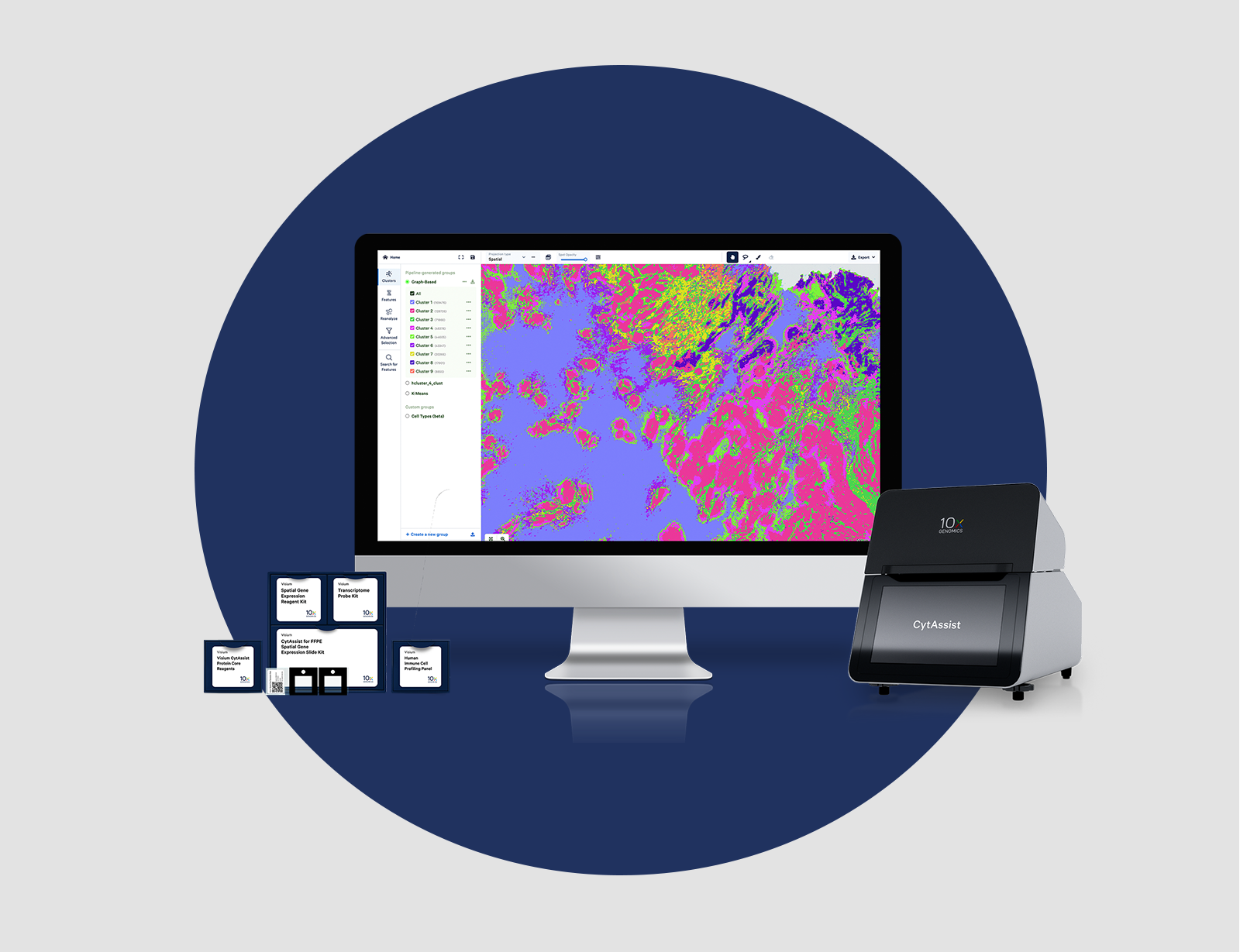
Spatial gene expression platform integrating histology with high resolution transcriptomic mapping.

In situ gene expression platform for targeted, high-plex spatial profiling at subcellular resolution.