NICU genomic sequencing support at GTAC@MGI, McDonnell Genome Institute
NICU genomics at the McDonnell Genome Institute

Rapid whole genome sequencing for critically ill infants

GTAC@MGI supports neonatology and clinical genetics teams with rapid whole genome sequencing for infants in intensive care. Our laboratory workflows are structured to deliver high quality sequencing data on a timeframe aligned with clinical decision making, in close partnership with the Department of Pathology & Immunology at WashU Medicine.

Using genome sequencing when standard diagnostics are inconclusive

Critically ill infants often present with complex clinical findings that do not point toward a single diagnosis. Rapid whole genome sequencing can evaluate all major variant classes in one test and provide clarity when standard workups are unrevealing.

Indications for sequencing

Congenital anomalies, seizures, metabolic instability, neurologic findings, or multiorgan involvement without a clear etiology.

A single comprehensive test

Whole genome sequencing detects copy number changes, structural variants, and single gene disorders in one assay.

Clinical impact

Published studies show rapid sequencing often informs medical management, guides additional testing, or clarifies prognosis.

A workflow aligned with clinical urgency

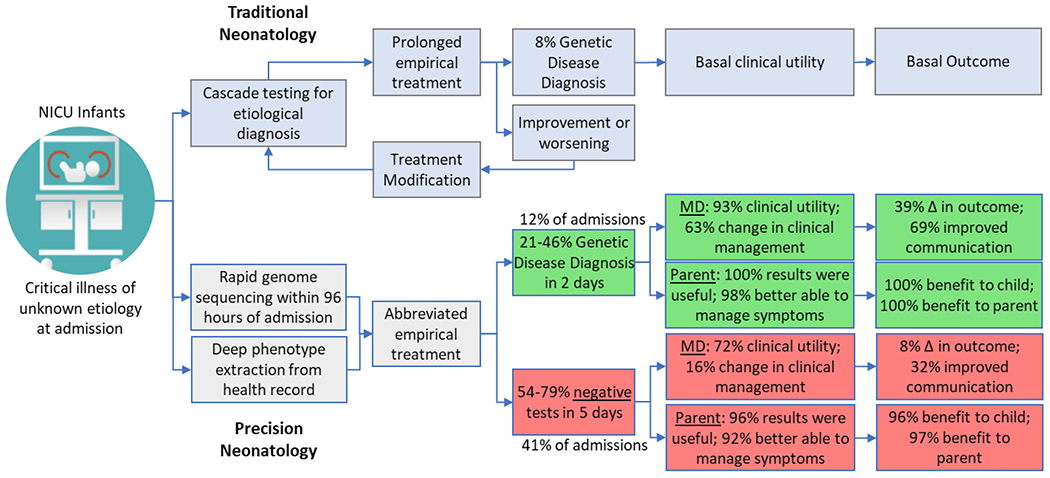
rWGS follows a structured workflow that moves samples from receipt to sequencing in several days, enabling clinical teams to begin interpretation as soon as run outputs are available.

Workflow diagram for rapid whole genome sequencing in NICU settings
Adapted from: Kingsmore SF, Cole FS. The role of genome sequencing in neonatal intensive care units. Annual Review of Genomics and Human Genetics. 2022;23:427–448. doi: 10.1146/annurev-genom-120921-103442.

Sequencing workflows aligned with bedside decisions

NICU rapid sequencing is a coordinated effort between GTAC@MGI and the Department of Pathology & Immunology. GTAC@MGI performs rapid whole genome sequencing and laboratory quality control. Clinical analysis, interpretation, and reporting are performed by the Department of Pathology & Immunology as part of standard clinical care.

What GTAC@MGI does

  • Coordinates with neonatology, clinical genetics, and Pathology teams to support rapid sequencing cases.
  • Processes small volume infant samples and parent comparators.
  • Runs PCR free whole genome sequencing with structured laboratory quality control.
  • Delivers sequencing run outputs to the Department of Pathology & Immunology for clinical analysis and interpretation.

What clinical teams do

  • Access sequencing run outputs generated by GTAC@MGI.
  • Launch and run clinical analysis workflows within the Department of Pathology & Immunology.
  • Perform clinical interpretation and issue clinical reports.
  • Integrate results into clinical documentation and downstream systems as appropriate.

Where genome sequencing adds clarity

rWGS is often informative for presentations that span multiple organ systems or do not fit a single diagnosis.

Suspected metabolic or mitochondrial disease

Unexplained acidosis, organ dysfunction, or recurrent decompensation.

Neurologic or structural findings

Congenital anomalies, seizures, tone abnormalities, or brain imaging differences.

Possible familial or inherited conditions

Situations where family history or recurrence risk informs diagnosis and management.

Discuss a NICU rapid sequencing workflow

If you are coordinating NICU care and need rapid whole genome sequencing support, we can connect the right GTAC@MGI and Pathology teams and align on sample logistics and timing.
Contact us
Thank you for your submission.

Stay Updated on GTAC@MGI Services and Events

Sign up to receive updates from the McDonnell Genome Institute on new technologies, upcoming events, and occasional promotions on services that support your research.

By submitting this form you agree to receive email from the McDonnell Genome Institute at Washington University School of Medicine. You may unsubscribe at any time. Your information will not be sold or shared with outside organizations.