

Clinical development relies on the integrity of underlying datasets. At every stage of a trial—whether early-phase safety studies or late-stage efficacy evaluations—decisions regarding a therapy’s trajectory depend on data that is accurate, reproducible, and interpretable. Research-grade standards are particularly critical when working with scarce or degraded patient material, where analytical precision determines whether samples can meaningfully inform endpoints and biomarker discovery.
High-quality, research-grade data ensures:
- Confidence in outcomes – Data that is accurate, reproducible, and free of noise allows sponsors and regulators to make informed decisions.
- Value from every sample – Patient samples are often limited, degraded, or difficult to process. Research-grade standards maximize what can be learned from them.
- Regulatory acceptance – Agencies demand rigorous evidence. Clean data reduces the risk of delays or failed submissions.
- Translational insights – Beyond endpoints, reliable data powers biomarker discovery, stratification, and mechanistic understanding.
When data quality is compromised, trials may be slowed or require repetition, reducing efficiency in advancing therapies.
How MGI delivers on data quality
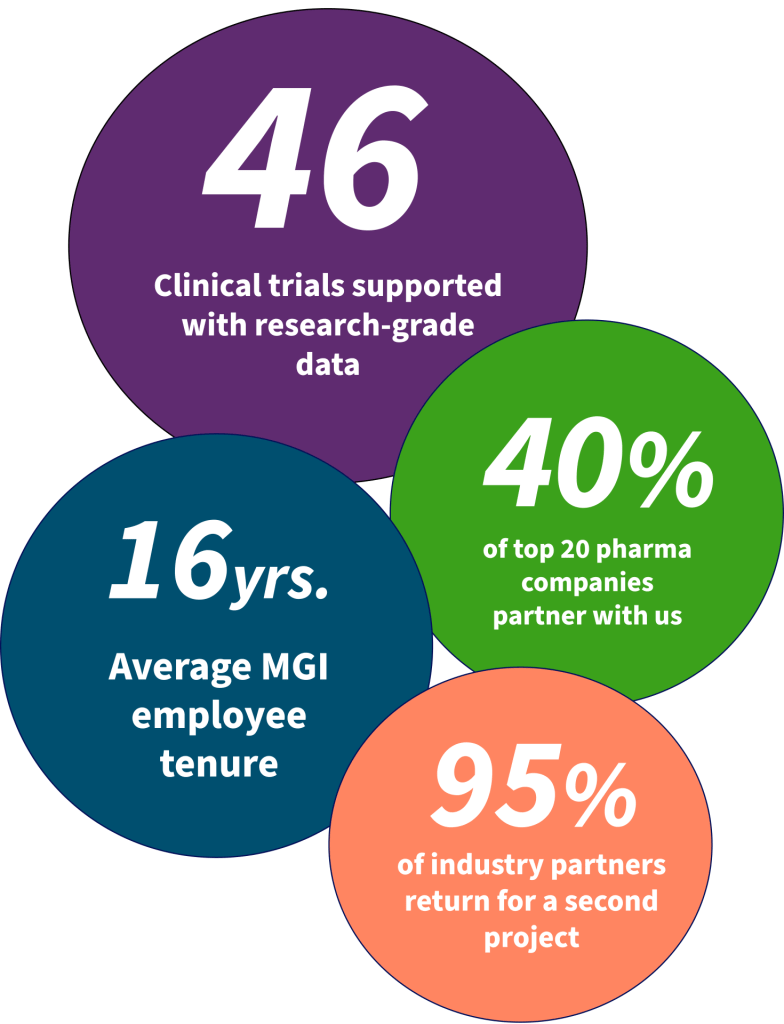
Over the past 15 years, the McDonnell Genome Institute (MGI) partnered with major pharmaceutical companies to generate research-grade data that drives clinical development. MGI produces reliable results from analytically challenging material such as FFPE tissue and limited biopsies, and integrates genomics, transcriptomics, proteomics, metabolomics, and advanced imaging within a single institute. A long-tenured scientific team and early access to next-generation platforms ensure that our analyses advance biomarker discovery and support clinical trial endpoints.
Examples from supported trials
These studies highlight how research-grade data can unlock insights even when working with limited or difficult samples. Our role is to ensure that critical translational endpoints are supported with reliable results.
PALTAN Trial – Pfizer, Phase II, breast cancer
Pfizer tested a neoadjuvant regimen (palbociclib, letrozole, trastuzumab) in patients with ER+/HER2+ breast cancer. The study used RNA and exome sequencing of paired biopsies before and during treatment to assess molecular response. GTAC@MGI performed the genomic analysis. RNA sequencing was conducted on tumor-rich biopsy samples from 16 of the 26 patients enrolled, reflecting limited RNA-seq availability due to sample quality and tumor content. Despite that, the data enabled PAM50 classification, Ki67 analysis, and pathway assessment, supporting the study’s translational endpoints.
Veliparib Trial – AbbVie, Phase III, lung cancer
This international Phase III trial evaluated whether adding the PARP inhibitor veliparib to standard chemotherapy could improve outcomes for patients with advanced squamous non–small cell lung cancer. To assess whether a gene expression signature (LP52) could predict benefit, RNA-seq was performed on archived FFPE tumor samples—material that is notoriously degraded and difficult to process. GTAC@MGI generated the transcriptomic data, enabling biomarker-driven subgroup analysis in one of the largest trials conducted in this patient population.
Translational support across the multi-omic spectrum
Clinical trials increasingly demand integrated analyses that extend beyond a single modality. At MGI, multi-omic approaches are applied at scale to maximize the interpretive value of every patient sample.
- Genomics and transcriptomics: expertise spanning bulk, isoform, spatial, and single-cell strategies
- Proteomics and metabolomics: high-throughput platforms capable of resolving complex biomarker signatures
- Cellular systems: patient-derived iPSC generation and targeted genome editing to model therapeutic response
- Advanced imaging: large-scale cell segmentation and functional imaging pipelines that link molecular and phenotypic data
This convergence of technologies enables consistent delivery of research-grade data, whether for pilot investigations or global Phase III cohorts. By integrating multi-omic datasets, we strengthen the translational bridge from molecular readouts to clinically actionable insights.
Ready to discuss your next project? Contact Us